Directory
Add URL
Search
New Listings
Most Popular
Highest Rated
Categories
Top
Pro Audio
HiFi Audio
DVD-Audio
SACD
Car Audio
Music
Internet Audio
Personal Pages
Channels
HiFi Audio
Home Theater
Pro Audio
Home Recording
Car Audio
MP3
Net Audio
AudioBiz
MusicBiz
Forums
Talkback
StraightWire
Media
About AudioWorld
Submit Material
Advertise
Link to Us
Contact Us
Audio Site Links
Audio Site Directory

| PRODUCT NEWS | Berkeley, CA, May 28, 2004 |
Indianapolis Cathedral Auditorium Tames Difficult Acoustics With Meyer
Self-Powered Loudspeakers
The recent installation of 19 self-powered loudspeakers from Meyer Sound into the auditorium of the Scottish Rite Cathedral in Indianapolis gives the city a distinctive performance venue – one that uniquely combines the lavish splendor of Tudor gothic architecture with the pristine clarity of advanced audio technology.
Built in the late 1920s, the cathedral stands as a landmark to both the noble past and future promise of Freemasonry. In earlier decades, admission to the cathedral had been largely restricted to members and special guests, but in recent years, the facility has been opened to a wider range of community arts, business and social events. Unfortunately, poor sound reproduction inside the 1150-seat auditorium precluded the room's use for events focusing on musical quality, as the cathedral's building services manager, Kent Watts, explains.
"A major foundation had been holding a fundraiser here every year in our ballroom, with an orchestra and operatic soloists," he recalls.
"But they had to erect a temporary stage and bring in sound and lighting systems, all at significant cost. The auditorium was better suited to the purpose, but it needed a major sound system upgrade. Fortunately, the foundation offered to help with generous funding, so we went ahead with it last year."
Indianapolis-based ESCO Communications was selected as the design-build contractor for the project, and the company's vice president of sales, Gary Dunn, notes that a Meyer Sound system was the front-runner from the outset, both for its quality and for the self-powered aspect of the products.
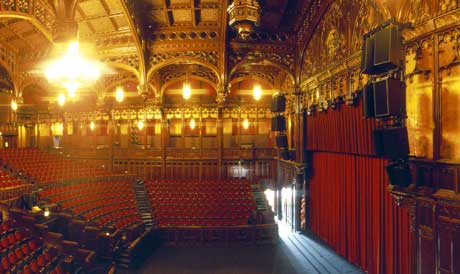
Meyer Sound Self-Powered Speaker Clusters Installed at the Scottish Rite
Cathedral in Indianapolis Perform Beyond Expectations in Difficult Acoustic
Environment
"We proposed a Meyer system from the start, primarily because we've always been impressed with the whole range of products," he says. "Also, with the Scottish Rite project, there were some severe limitations as to what we could do with amplifier racks, which again lent itself to a Meyer solution."
To preserve the historic integrity of the auditorium, the only concession allowed for the new system was opening two small holes in the ceiling. All main loudspeakers had to be suspended in single clusters on each side of the stage.
Dunn sent CAD drawings of the room to Meyer Sound's Design Services department, who then employed Meyer Sound MAPP Online® acoustical prediction software to configure a system offering seamless coverage for both the main floor and balcony seats.
Although a system model based on M Series arrays provided excellent results, the depth of the array did raise some issues regarding the obstruction of architectural details. Going back to MAPP Online, Design Services created a new arrangement with essentially equivalent results using point-source clusters: two MSL-4 horn-loaded long throw loudspeakers per side, each underhung with a pair of PSW-2 high-power flyable subwoofers, beneath which a pair of CQ-2 narrow coverage main cabinets and, at the bottom, two UPA-1P compact wide coverage loudspeakers for near fill. Three UPM-1P ultra-compact wide coverage loudspeakers were installed on delay lines for upper balcony coverage.
ESCO Communications applications engineer Phil Hodson was charged with the wiring details and supervision of installation logistics.
"Overall the results proved very impressive," says Dunn.
"We were initially concerned about the high upper balcony, since it's a little echo chamber up there. We thought we might have to do some acoustical treatment, but the Meyer UPMs do a wonderful job there."
"The new system has exceeded everybody's expectations," remarks Watts. "It's so far beyond what we had before that it really doesn't seem like the same room. It's the difference between the sound of a high school gymnasium and that of a good concert hall."
The difference is so profound that Watts has found himself somewhat surprised when acts that have used the room in the past have returned for recent performances. "They take their equipment off the truck and haul in their sound systems out of habit, and then come in and see what we have now. They can't believe we've upgraded to that extent. So they roll their gear back out, and then say something like, 'Why didn't you tell us that before we took everything off the truck?'"
Meyer Sound Laboratories Web Site