VTL’s New Siegfried 800 Watt Reference Monoblock Amplifier Features ‘Tube-Smart’ Self-Adjusting Technology

The new all-tube monoblock reference amp from VTL (Vacuum Tube Logic), first shown last month at the Home Entertainment 2003 show in San Francisco, is designed to make high-end tube amplification easier to use, through self-adjusting technology that optimizes performance automatically.

The new Siegfried 800 Watt Reference Monoblock Amplifier incroporates “tube-smart” technology that VTL’s engineering team has been developing over the past five years. It provides continuous real-time feedback of important performance parameters and automatically self-adjusts to maintain optimum settings, using software control to dramatically extend tube life.

VTL says that sound quality has also been taken to a new level with increased dynamics, more realistic instrumental timbres, and a harmonic richness nearer to live music.

“With our new ‘smart’ amplifier, we have truly put technology in the service of music,” says VTL president Luke Manley. “With all of the guesswork removed from the amplifiers’ operation, the user can simply sit back, relax, and enjoy the music.”

The Siegfried has been under development since 1996, when VTL introduced its previous reference model, the 1250 Watt Wotan amplifier. At the time, VTL described the Wotan as “the culmination of all we know about amplifier building at VTL.” But even then, the company recognized that the growth of home theater meant that amplifiers were being called on to perform an array of new functions in the home, and that VTL’s tube equipment would need to change to fit into modern home entertainment systems.

VTL identified reliability and consistency of tubed components as key issues that had to be addressed.

Luke Manley and VTL set these design goals for the new reference model:

  • It should deliver a new sonic standard, unsurpassed sound quality as well as excellent measurements on the test bench
  • The amplifier must be able to drive a wide range of speaker types to their optimal performance, with consistent performance under all conditions
  • The amplifier must be self-optimizing and provide a full range of diagnostics for sustaining peak performance
  • The operation of the amplifier must be intuitive and user-friendly while providing flexibility in its control functions, for integration with modern home theater systems

“The R&D process ended up being an intensive cross-disciplinary collaboration between multiple teams of engineers in different parts of the country,” says Luke Manley. “Tube circuit designers, power supply experts, software engineers, control circuit experts, and industrial design specialists all had a hand in shaping Siegfried.”

The quest to make Siegfried “smart” was a major part of the design process. VTL was committed to eliminating the continual tweaking and guesswork that usually come with owning large tube amplifiers. Automatic self-regulation was understood to be the key to keeping Siegfried operating at peak performance.

To that end, engineers embedded a logic-controlled automatic tube biasing circuit inside the amplifier to ensure that Siegfried is running optimally at all times. A full range of diagnostic functions were also included to let users know which tubes need to be changed, amplifier operating time, tube life, real-time AC voltage and more.

Siegfried’s sound quality took a significant leap forward, due in part to the use of new precision-regulated power supplies. Benefits of the new design include increased dynamic headroom and a tighter, more tuneful bass. A balanced input stage keeps the noise floor vanishingly low.

Siegfried’s physical package has been given special attention in the design process. The thick and extremely rigid chassis (provided in a tower configuration) is clad in non-magnetic material and rests on large non-resonant feet to banish mechanical interference.

The sleek, modern appearance of Siegfried matches the cosmetics of VTL’s TL7.5 Reference Preamplifier. A curved fascia is inset with a digital readout and three buttons.

“I couldn’t be more pleased with the way our new ‘smart’ amplifier has turned out,” says Luke Manley. “Siegfried has surpassed everyone’s expectations with respect to sound quality and ease of use. This is an amplifier you can turn on and forget about. Just sit back, relax and enjoy the music.”
VTL Web Site

Father of MP3: For My Next Trick… Unlimited Virtual Audio Channels!

Karlheinz Brandenburger. Fraunhofer Institut Integrierte Schaltungen (IIS).

These names may not strike a chord with you right away, but they have undoubtedly had an influence on your experience of audio and music.

Karlheinz Brandenburger is a leading researcher in audio technology, and head of the Fraunhofer IIS. He’s also known as “the father of MP3.” Under his leadership, the Fraunhofer Institut developed the MP3 audio encoding format that has transformed the music and audio industries over the past 10 years.

Whether you love or hate the consequences of that revolutionary research, there’s no denying its transforming impact.

And now they’re at it again – except that this time, the research is leading in the opposite direction on the audio quality scale.

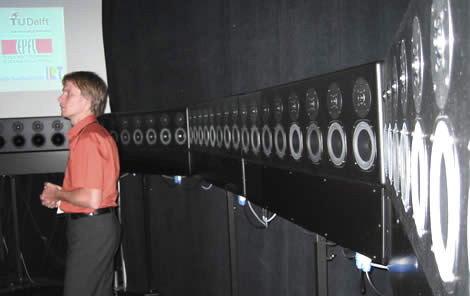
Hundreds of low-cost, full-range speakers create an unlimited number of apparent channels and audio point sources in the Wavefield Synthesis demonstration at the AES/Banff International Conference on Multichannel Audio

One of the most prominent topics at the Audio Engineering Society’s International Conference on Multichannel Audio taking place in Banff, Canada – as well as the most compelling practical demonstration – is Wavefield Synthesis.

Along with Mr. Brandenburger and Fraunhofer IIS, practical Wavefield Synthesis (WFS) has been developed by a European research consortium called Carrouso, with participation by Studer, France Telecom, and several other research facilities, including France’s IRCAM, Delft University (The Netherlands) and the Institute for Broadcast Technology (IRT, Germany).

Briefly explained, WFS makes it possible to create and control an audio soundfield in which the “sweet spot” (the area where the apparent spatial representation of the audio being reproduced is ideal) is practically the entire room. It can be applied to rooms of pretty well any size, so the technology can be used in movie theaters, concert halls, or living rooms.

WFS doesn’t just deliver an enormous “sweet region.” It also provides a spatial image of very high resolution and stability, and allows audio engineers and producers to manipulate the placement of sounds with unlimited flexibility.

So for instance, you might decide to simulate 2 speakers placed in the normal stereo system L/R configuration in a WFS room, and re-create playback of a regular 2-channel recording. Or you could simulate a 5-channel surround system, by placing virtual speakers appropriately. Or a 100-channel surround system!

Wherever you stand (or sit) in the listening area, the “left” and “right” or “front” and “rear” audio signals will appear to be in the correct position for optimal listening.

But this only scratches the surface of the possibilities of WFS. Why bother emulating loudspeaker setups, when you can simply mix your music in WFS? In other words, place the various instruments, effects and elements of a multitrack recording in “virtual pan spots” throughout the listening space.

This may sound like wishful thinking, but the amazing thing about WFS is that it actually works, exactly as described. The audio professionals attending the AES Banff conference have been able to hear for themselves that Wavefield sounds great. The potential appears to be unlimited.

In the context of multichannel technology, WFS effectively eliminates the discussion of “how many channels are enough” by putting an unlimited number of channels into play (although the analogy to “channels” isn’t really appropriate).

Let’s put it this way: if Wavefield Synthesis becomes practical – and it may become practical in as little as a few years – the jump from 5.1 surround to WFS will be at least as dramatic as the jump from 2-channel stereo to 5.1 surround. I’d say quite a lot more dramatic.

Now here’s the problem. WFS requires massive number of loudspeakers. The system installed for demo at AES Banff (see photo) involved about 200 drivers, arranged in panels containing 8 two-way speaker systems and 8 50W amplifiers each. Ideally, the speakers encircle the listening area completely.

WFS technology depends on this concept of an array of closely-spaced loudspeakers. It also requires a great deal of digital signal processing power to perform “convolution” of the audio signals with appropriate filters that create the virtual spatial representation.

The computer processing requirement is much less of a practical concern than the quantity of loudspeakers involved.

Karlheinz Brandenburger has no qualms about the practicality of Wavefield Synthesis. For applications in movie houses, it’s already here. A theater in Ilmenau, Germany is already in operation with a fully-functioning WFS sound system (89 seats, 24 WFS panels with a total of 192 speakers), and more cinema and live-performance theaters, in Germany and elsewhere, will be equipped with WFS later this year.

For the home? Well, WFS speaker arrays work just fine as flat panels, they can be architecturally integrated with living spaces in any number of ways. WFS doesn’t require exotic or costly speakers, just ordinary low-cost full-range drivers (and presumably a subwoofer or two to handle the bottom end). So it may not be too far-fetched to imagine WFS in the home.

So heads up, audiophiles and home theater installers: start thinking about re-configuring your listening spaces to accommodate a truly “surround” loudspeaker technology. When it arrives, WFS audio for the home will be stunning.

The AES 24th International Conference Multichannel Audio: The New Reality continues in Banff through Saturday (June 28, 2003).

Kevin Elliott

AES 24th International Conference: Multichannel Audio

Fraunhofer IIS Web Site

Massenburg on Multichannel: Do Great Work, The Audience Will Follow

After enumerating the challenges facing audio professionals working to produce multichannel popular and classical music recordings, as well as pointing out the medium’s modest successes, renowned audio engineer George Massenburg threw down the gauntlet to his Audio Engineering Society (AES) colleagues:

“We all have to do great work, develop the new techniques we need, and produce great demo-quality multichannel recordings,” he encouraged, in his Keynote Address to nearly 200 engineers, mixers and researchers attending the AES International Conference on Multichannel Audio, which began today at The Banff Centre in the Canadian Rocky Mountain resort town of Banff.

“We have to charm artists and listeners to join our dance… keep on trying until it’s too compelling to ignore.”

Mr. Massenburg is uniquely qualified to comment on both the art and science of multichannel. Over his 30-year career, he has been a leading engineer in both the recording studio and in research and manufacturing. In the studio, he has worked on more than 200 albums with front-line artists like Linda Ronstadt, Toto, The Dixie Chicks, Lyle Lovett and Aaron Neville. In the hardware field, he has pioneered technology such as parametric equalization, and heads his own company, George Massenburg Labs, that makes studio gear including mixing and automation systems, mic preamplifiers, equalizers and other audio processors.

He has received Grammy, Academy of Country Music, and TEC awards for production and recording, and a rare Grammy Award for Technical Achievement – one of only four such technical awards given in the history of the Grammys.

“As popular music producers, we’re still struggling to make multichannel as effective for pop as it is already for classical recordings,” Mr. Massenburg says. “We lack some of the important tools we need – reverbs that can create realistic small-room environments; tools for moving sounds around [panning] in surround.”

Mr. Massenburg weighed in on some of the controversial issues that crop up often in discussions of how the multichannel formats have been presented to consumers.

“I’m going to skip right over formats [DVD-Audio vs SACD]. They’re about even, so we need to just go on,” he said.

“But please, let’s make all five speakers (in a home surround system) equal, with the same full range response all around.”

Commenting on the growing reluctance of music labels to invest in state-of-the-art production technology, as well as in multichannel mixes, Mr. Massenburg asked audio professionals to never compromise their standards of audio quality.

“A great example of the difference quality and technology makes is the big Faith Hill hit album last year (Cry, Warner Bros.). Just compare the dirty, noisy stereo mix on CD, to the clean, brilliant-sounding surround mix for DVD-Audio made by Elliot

He also encouraged engineers to make multichannel elements a standard part of the deliverables from their recording projects.

Left to right: Karlheinz Brandenburger (Fraunhofer Institute); Jean-Marie Geijsen (Philips, Pentaton); David Griesinger (Lexicon); Kimio Hamasaki (NHK Japan Broadcasting); George Massenburg (GML); Gunther Theile (Institut für Rundfunktechnik)

Later in the day, George Massenburg took part in a panel discussion on Problems with the Popularization of Surround Formats for Music, with other leading researchers and practitioners of multichannel audio.

Along with Mr. Massenburg, the panelists included David Griesinger (like Massenburg, an equipment designer as well as recordist); recording engineers Jean-Marie Geijsen (Netherlands) and Kimio Hamasaki (Japan); and researchers Karlheinz Brandenburger (“the father of MP3”) and Gunther Theile.

In this forum, the panelists and audience found concensus that 5.1 surround is effective and compelling, a huge step forward from 2-channel stereo, and the right standard to carry on with in bringing multichannel to consumers.

The liveliest discussions centred on…

* the coming shift from discrete 5-channel (plus LFE) playback to a future where super-powerful DSP-enabled home entertainment systems will calibrate themselves to make use of however many speakers of whatever design and configuration are available in the home, creating an idealized output from the discrete source materials available (2-channel, 5.1-channel, or other);

* the importance (or not) of the “sweet spot” in a home playback system, and the ways multichannel audio can create a larger “sweet region” that improves the consumer’s experience of music;

* the advantages of using more than 5 surround speakers, in particular by adding 2 more speakers in the “front” (far left / left / center / right / far right), to improve the stability of the audio image; or by adding 2 additional rear surround speakers, to reduce the problems associated with sitting too close to an individual surround speaker in typical home listening rooms.

The AES 24th International Conference Multichannel Audio: The New Reality continues in Banff through Saturday (June 28, 2003).

Kevin Elliott

AES 24th International Conference: Multichannel Audio

George Massenburg Labs Web Site

Blaupunkt’s New Phoenix and Sacramento CD Head Units Feature Aggressive Styling and Optional MP3 Playback

Blaupunkt has introduced two new models in its value-oriented V-Line of car stereos.

The Sacramento CD33 CD receiver is priced at $259 (US), and offers 50 Watts of power into each of four channels. It features Blaupunkt’s high quality standard CD transport, and it can be used in conjunction with a Blaupunkt CD changer to control up to 10 discs’ worth of music.

Like all Blaupunkt radios, the Sacramento also features a high-sensitivity tuner, including 18 FM and 12 AM presets. An optional credit-card remote allows you to control all major functions of the head unit from anywhere in the cockpit.

The front-panel ID3 display and included credit-card remote control make for easy navigation of MP3 files on Blaupunkt's Phoenix MP33 head unit

The Phoenix MP33 CD/MP3 receiver is priced at $349 (US). In addition to all the standard features of the Sacramento, the Phoenix is also fully compatible with CD-R/RW discs encoded with MP3 files.

The Phoenix has a faceplate ID3 tag display that shows artist and song title information embedded in MP3 files. Along with the included credit-card remote control, the ID3 display makes it easy to locate and select from as much as 10 hours of music on a single MP3 CD.

Each model delivers and features aggressive styling with flip down detachable faceplate, blue and red backlit buttons, and a three-color red/white/blue panel display.

Blaupunkt USA Web Site

Banff Hosts AES International Conference on Multichannel Surround Audio

Banff, the spectacularly scenic resort town in the Canadian Rockies – and incidentally the home of this publication, AudioWorld! – is the place to be this week, for audio professionals working with multichannel sound.

The Banff Centre, and its highly-regarded Music & Sound post-grad program for audio engineers, is hosting the Audio Engineering Society’s 24th International Conference, Multichannel Audio: The New Reality.

A quick run-down of some of the key names and organizations participating in a busy schedule of research topics and practical demonstrations will give you a sense of the calibre of the event: George Massenburg, Tomlinson Holman, David Griesinger, Bob Ludwig, Michael Bishop, Steven Marcussen, Meridian Audio, DTS, Dolby, Lexicon, Fraunhofer IIS/AEMT, NHK, ORF, Swedish Radio and Philips.

The 3-day event runs June 26 – 28, 2003 at The Banff Centre. The program features more than 40 research presentations in the form of papers and posters, as well as all-day seminar, sound demonstration and corporate demo sessions. It all begins on Thursday morning (June 28) with a keynote address by renowned producer and engineer George Massenburg.

As with all Audio Engineering Society conferences, the content is a blend of cutting-edge research – topics that are well outside the radar range of even the most enthusiastic audio enthusiasts; hard-core tech talk, on topics such as acoustic measurement techniques and audio encoding algorithms; and down-to-earth practical tutorials and demonstrations of techniques and technology that audio professionals are using today, to make multichannel recordings for DVD-Audio and SACD releases.

Conference Chair Theresa Leonard says that with nearly 200 audio professionals already signed up to attend the conference, the Banff Centre’s excellent facilities will be stretched for some of the most popular sessions.

On the practical side, some highlights include:

  • Mixing, Mic’ing, Mastering Master Class – with 4 top engineers discussing their creative and technical approaches to multichannel
  • Toward the Popularization of Surround Sound Systems, roundtable discussion on hardware and software engineering, and their relationship with the sales and installation of surround systems for home music listening
  • DTS and Philips demonstrations of recent and up-coming surround music releases
  • Demonstrations of a multichannel modular microphone array for accurate mic placement in surround recording
  • Ambiophonic 2D and 3D Surround Sound demonstrations
  • Several papers and demonstrations focused on microphone placement techniques for 5.1- and 10.2-channel recording
  • Sessions on the use of 5.1 surround audio in radio broadcast and documentary work
  • Continuous surround panning technology for 5-speaker mixes

For the more experimentally oriented, some highlights might be:

  • Wavefield Synthesis – which seems to be the research topic of the year, with two full paper sessions and several sound demonstrations devoted to multi-dimensional, many-speaker arrays that aim to create precise sound localization over a large listening area
  • Hierarchical multichannel sound transmission via Meridian Lossless Packing (MLP) – would you believe 5.1-compatible 16-channel recordings on DVD-Audio discs?
  • Realtime collaborative audio production via high-speed next-generation Internet – using transmission delays to create reverberation effects
  • And the AudioWorld Editor’s current nomination for Best/Most-Obscure Paper Title: Modeling Spatial Sound Occlusion and Diffraction Effects Using the Digital Waveguide Mesh

AudioWorld will be at the Banff AES Multichannel Audio conference to bring you coverage of the highlights.

Multichannel Audio: The New Reality Web Site

Day 1 Report – June 26