Avid Technology Reports 3rd Quarter Loss, Appoints New Marketing V-P

Tewksbury, MA. Avid Technology Inc. has reported financial results for the third quarter of its fiscal year, ended September 30, 1996. For the third consecutive quarter, Avid recorded a net loss on its operations.

The loss amounted to $6.75 million (U.S.), against reported revenues of $114.7 million. This loss included one-time charges of $8.8 million associated with the decision not to release the Avid Media Spectrum product line.

“Our priorities remain the same as they have been for the past two quarters,” commented William J. Miller, Avid’s Chairman and CEO. “We are focused on generating cash flow, returning to profitability and developing and selling innovative products that meet the needs of our customers. We have instituted several companywide programs designed to improve our operating efficiency and we are scrutinizing all aspects of our business to achieve progress toward these goals.”

Two weeks ago, Avid announced the appointment of Clifford A. Jenks to the newly-created position of V-P, Worldwide Sales and Marketing.

Jenks was most recently COO of Zenith Data Systems. Prior to that, he was Apple Computer’s V-P of Sales and Marketing Support, where he was responsible for U.S. sales operations, marketing, channel finance and administration.

Avid Technologies is the parent company of Digidesign Inc., which manufactures the popular ProTools series of digital audio workstations.
SRS 3D Sound On Board the New UMAX 240 MHz PowerPC Mac Compatible

Santa Ana, CA. SRS Labs has announced that UMAX Computer Corp. is including SRS 3D Sound technology in its hot new SuperMac C600/240 PowerPC desktop computers, shipping this week. SRS 3D will also be built in to the UMAX C500 Mac compatible, scheduled to begin shipment in November.

According to the company, SRS 3D Sound is now available in models from every manufacturer currently shipping Macintosh OS-compatible computer products.
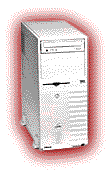
The SuperMac C600/240 is a full-featured machine in a mini-tower system enclosure. It includes 24 MB of RAM (expandable to 144 MB), 256K of level 2 cache (upgradeable to 512K or 1 MB), 1 MB of video memory on the motherboard, an 8X SCSI CD-ROM drive, 28.8 bps fax/data modem, 2.1 GB hard drive, 1.44 MB floppy drive, and a bundle of software. UMAX is touting its new offering as “the fastest desktop PC on the planet.”

SRS 3D Sound enhances any audio signal, including mono, stereo, surround sound, or a signal encoded with a 3D sound positional technology. It requires no encoding or decoding and it does not rely on artificial signal manipulation such as time delay or phase shift. Other computer and consumer audio manufacturers currently shipping products with SRS include Sony, Kenwood, RCA, Nakamichi, Sharp, Packard Bell, NEC, Toshiba, Apple, Kurzweil, Pioneer, Samsung, Daewoo, Hyundai and LG Electronics.

Harrison’s TV950 Making Inroads at Major Broadcast Studios

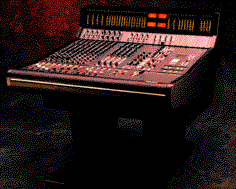
Nashville, TN: The TV950 on-air console, introduced by Harrison by GLW at April’s NAB National Convention in Las Vegas, has been selected for a couple of high-profile installations in Belgium and the U.S.

Harrison has shipped a 52-wide TV950 to the Belgian Radio and Television Network (BRTN). It will be installed in a new BRTN mobile unit for use in live broadcast feeds. The console is configured with 30 mono mic/line inputs, 6 stereo inputs and 6 group modules. Along with standard assignable fader start logic and two program masters, this TV950 is equipped with a 24 multitrack busing on all inputs, groups and master modules, for multitrack output level control.

In the U.S., A.H. Belo Corporation has ordered a TV950 for its new Washington, D.C. bureau. This is a smaller configuration, with with 6 mono mic/line inputs, 6 stereo line inputs and 4 stereo groups, all equipped with mix-minus feed modules and standard assignable fader start logic. The master section contains 2 program masters, monitor module, dual studio module and a master communications module.

According to Dave Hunn, Chief Engineer of Belo’s flagship station, WFAA Dallas: “We chose the TV950 for its flexibility and very complete IFB/mix-minus system, which will meet most any ‘live shot’ situation or production setup. This, combined with the quality and reliability of the Harrison products already in use at other Belo stations made the choice easy.”

The new Washington bureau will provide news facilities for the A.H. Belo Corporation-owned television stations and newspapers. Broadcast facilities will include five edit suites, a production control room and fully-equipped studio. Planned uses include multiple simultaneous live feeds and pre-produced shows which will be shared by all Belo stations.

The TV950 is designed specifically for television broadcast applications. It received an Editor’s Pick of the Show award from Television Broadcast Magazine at the NAB Convention where it was introduced in April (1996). Its available features include assignable machine logic, three mix-minus options, either 4 or 8 stereo buss groups, mono or stereo input modules, control room/studio/comm module with tallys and automated router interface, and LCRS panning for surround applications. Frame sizes may be configured for up to 64 positions, in virtually any combination of stereo or mono inputs, groups, communications and program modules. Pricing begins in the $40,000 (U.S.) range.

QSound’s QXpander Arrives in Japan via AIWA

Calgary, Canada. QSound Labs has announced the entry of its QXpander™ surround sound technology into the Japanese consumer electronics market. AIWA Co. Ltd. has recently introduced a QXpander-enhanced multimedia speaker in Japan.

According to the company, this is the first of several projected products using QSound’s patented surround sound technology that AIWA will introduce in Japan. The products are targeted at both the computer peripheral and consumer electronics markets. All will include QSound’s QXpander analog chip, which is manufactured, under license, by Mitsumi Electric Co. of Japan.

AIWA has a history of industry innovation. It produced Japan’s first cassette tape recorder, first stereo cassette deck and it was the first company to manufacture DAT hardware. Representatives of QSound Labs say they are “very pleased that AIWA now has another first, with its introduction of QSound-enhanced products.”

Spatializer Revenues Up, Net Loss Also Increases

Woodland Hills, CA. Spatializer Audio Laboratories today announced financial results for its third quarter of fiscal 1996, ended September 30, 1996. Revenues were $472,200 (U.S.), an increase of 76 percent over the third quarter of fiscal 1995. The company reported a net loss of $1,101,700 for the quarter, compared to a net loss of $849,822 a year earlier.

Spatializer reported that nine new OEM licensees were added during the quarter, bringing the total to 44 chip licensees. Also, nine new game developers signed up for the company’s Spatializer 3-D MAP™ positional audio enhancement software for Windows® ’95. The increase in licensing reflects both a new “bundled” licensing arrangement with Matsushita Electric Co., and a favorable ruling by the courts in a long-standing patent litigation with QSound Labs, Inc.

“The uncertainty and costs associated with twenty-two months of patent litigation are at long last behind us,” said Steven D. Gershick, President and CEO of Spatializer. “We have already begun to see very positive and immediate effects of this resolution in both substantial licensee growth and increased Spatializer chip sales. [also] we have seen our R&D investment begin to bear fruit during the quarter with the introduction of our N22™ Digital Virtual Surround™ technology for multi-channel discrete digital audio systems for DVD/DVD-ROM and home theater markets.”