MUSICAM Expands Range of Portable Audio Codecs/Mixers for ISDN and POTS

Los Angeles, CA. Some of the most interesting new product action at last week’s World Media Expo and NAB Radio Show at the Los Angeles Convention Center was in the area of codec and remote link technology for sending high quality audio point-to-point via ordinary telephone service or ISDN lines. The most energetic manufacturer on the WME floor in terms of new products was MUSICAM U.S.A.

Leading the lineup for MUSICAM was an enhanced version of the CDQPrima™ series of codecs for ISDN, which the company claims is already the fastest-selling audio codec on the market. The key new feature of the enhanced model is the addition of Layer III MPEG compression capability. With Layer III, the CDQPrima can now deliver 15kHz mono audio over a single ISDN “B” channel.

Front panel of the MUSICAM CDQPrima 120 Audio Codec

Added to the unit’s implementation of enhanced Layer II MPEG (MUSICAM®), the Layer III capability makes the CDQPrima extremely versatile and compatible. In addition to high quality digital audio, mono or stereo, it delivers SMPTE timecode, two ancillary data channels, eight relay contact closures, plus command and control channels, all on a single ISDN line.

Also on the ISDN transmission front, MUSICAM unveiled two new portable codecs with built in mixing capabilities. The top-of-the-line Olympian™ offers bidirectional stereo audio with no compromises. It includes the same MPEG Layer II (MUSICAM) and Layer III algorithms as the codec-only CDQPrima series. In addition to mono and stereo transmission, it supports dual-channel send of separate mono programs over two ISDN “B” channels. It can also send voice-grade analog audio over standard phone lines, when ISDN is unavailable.

MUSICAM's Olympian™ Stereo ISDN Portable Codec/Mixer

The company claims ultra-low distortion (0.01% THD+N) and superior signal-to-noise ratio (greater than 90 dB) for the Olympian. The standard configuration includes a built-in universal ISDN terminal adapter with integrated NT1, three mic inputs with stereo pan, a stereo line input, AES/EBU digital inputs and balanced line out. It also features numerous convenience features such as a snap-shot memory that saves presets of all operating parameters, including level settings, stereo pan position, ISDN numbers, bit rates, line format algorithm and mode, and sampling rate. The Olympian can match an incoming signal’s algorithm, mode, sampling rate and bit rate automatically.

For applications where absolute audio quality is less important, such as news gathering and voice over, MUSICAM introduced the RoadRunner™ portable codec/mixer. It offers similar automatic functions and convenience features as the Olympian, with MUSICAM enhanced Layer II and Layer III MPEG algorithms. But it is limited to mono send of a 15 kHz signal on a single ISDN “B” channel (or analog audio via standard phone line), has two mic inputs plus one mic/line input, and no digital I/O.

The RoadRunner™ Mono ISDN Portable Codec/Mixer

Finally, at the low end of its new product intros, MUSICAM brought out a studio version of its FieldFone audio codec for regular phone lines. The StudioFone™ is intended as the studio side of a field reporters’ link, enabling broadcast quality digital audio back to the studio via a single regular analog phone line. Both the FieldFone and the StudioFone offer frequency response approaching 9 kHz, and a “Sound Shaper” feature to sculpt the frequency response for optimum quality when sending music or other program involving higher bandwidth.

Enco Shows DADPRO Digital Audio Delivery System

Los Angeles, CA. ENCO Systems Inc. is exhibiting the DADPRO on-air, management and production system at WME. The digital audio delivery system is designed for live-assist, automated or satellite-programmed broadcast applications. The DAD workstation can replace all of the traditional recording and reproduction equipment found in a typical broadcast studio. It runs on non-proprietary computer hardware and uses industry-standard network architecture.

DAD interfaces with all commonly available professional broadcast equipment such as multichannel editors, consoles, routing switchers, and satellite receivers. It also supports wide-area networking, which allows any number of facilities to be linked and to share audio files as well as other data globally.

ENCO is also showing two ancillary products that combine with DADPRO to provide total forward control of localized spots, ID’s, and other audio, as well as scheduling instructions: the DADSAT satellite-based store forward management system, and the DAD JR low-cost workstation for unmanned downlink applications.

Electric Works Introduces Digital Cart Machine

Los Angeles, CA. Electric Works Corp. is introducing what it describes as the first professional digital cart machine at WME. The AXS™ PRO CART is software that replaces obsolete audio cart machines or earlier generation digital audio equipment in the broadcast Control room.

The software provides simultaneous operation of all the user tools including log play, instant play buttons, a cart stack and an instant record mode for phone calls or other quick recording. Up to eight audio sources may air simultaneously each with its own fader on screen. In addition, AXS PRO CART includes a complete digital audio production room and a multi-clip digital audio editor (Lazer Blade™).

The main interface window of Electric Works AXS™ PRO CART

“AXS PRO CART has a number of unique features, including total simultaneous operation of all functions without switching screens,” says Electric Works President Pete Charlton. “This includes the instant SoundStream recorder and all the playback functions with up to eight stereo audio sources on the air simultaneously.”

Electric Works supplies AXS PRO CART in a software-only version that works with customer-supplied audio cards; and as a packaged system with Electric Works’ own professional spec MPEG/WAV audio cards for Windows ’95 computers. The software alone lists at $1,000 (US), and the software/hardware package goes for $2,000 (US).

Today’s Highlights at World Media Expo & The NAB Radio Show

The SMPTE (Society of Motion Picture and Television Engineers) program moves into the audio spotlight at World Media Expo in Los Angeles today, with a strong paper session on “Audio: The Widescreen Experience”

The session is chaired by Ioan Allen of Dolby Labs, and it features presentations by a number of leading experts in applications of high-quality audio for film and video. Here’s the line-up:

  • “Three-Way Loudspeaker Systems for Motion Picture Use,” presented by John Eargle and Mark Mayfield of JBL Professional, and David Gray of Dolby Labs
  • “Artists and Engineers, Friends and Enemies,” Randy Thom of Skywalker Sound
  • “The Influence of the Sound System Upon the Wide Screen Experience,” Michael Leader of Leader Acoustical Lab
  • “Multichannel Sound Monitoring for Single-User Environments,” Tomlinson Holman of TMH Corp.
  • “Red LED Reproduction of Cyan Stereo Variable Area Dye Tracks,” a panel discussion featuring Paul Goldberg (Zoran Corp), Ioan Allen (Dolby Labs), Frank Ricotta (Technicolor Inc.) and Richard Sehlin (Eastman Kodak)
  • “Remote Dialog Replacement via ISDN,” Robert Winder and Michael Chewey of Warner Hollywood Studios

On the NAB program at World Media Expo, the Radio Show Luncheon will be headlined by country music star Dolly Parton. Parton, who is also a radio station owner, will give the keynote talk, and present the 1996 NAB National Radio Award to Edward F. McLaughlin, Chairman and CEO of EFM Media Management.

The award to McLaughlin recognizes his years of successful leadership and innovation at ABC Radio Network, where he was President from 1972 – 1986; and more recently at his own EFM Media.

New Products at World Media Expo & NAB Radio Show in Los Angeles

ATI NanoAmp Series Mini-Mixers

Los Angeles, CA. Audio Technologies Inc. (ATI) introduced several new modules to its NanoAmp product line at World Media Expo here today.
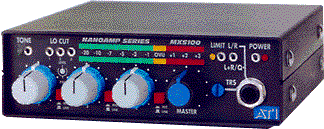
A trio of mixers and input expanders heads the ATI new product list. The MX100 is an inexpensive three input mixer with low-noise balanced, switchable mic and line inputs, phantom power, and an adjustable headphone output. The main outputs are +22dBm, low distortion, capable of driving both balanced and unbalanced lines. The unit features XLR type connectors in and out, plus and bright 3-color LED metering.

ATI's NanoAmp MXS100 3-input stereo mixer

The NanoAmp XPS100 and XPS200 expanders add additional inputs to the MXS100. The XPS100 provides four panned mic/line inputs and stereo buss out; the XPS200 offers two stereo line level inputs and stereo buss out. Both units plug into the MX100 for power and audio output with included cables. Multiple XPS modules can be used with the MXS100 in stacked or horizontal desk and rack mount configurations.

List pricing for the new NanoAmp mixer modules is $799 (US) for the MXS100, $549 (US) for the XPS100, and $379 (US) for the XPS200.

ATI also introduced the NanoAmp L200 2-channel line amplifier; and the BGD200 2-channel meter display, with phase indicator and headphone outputs, available in both VU and PPM versions (list $329 US each).