New Products at World Media Expo & NAB Radio Show in Los Angeles

ATI NanoAmp Series Mini-Mixers

Los Angeles, CA. Audio Technologies Inc. (ATI) introduced several new modules to its NanoAmp product line at World Media Expo here today.
A trio of mixers and input expanders heads the ATI new product list. The MX100 is an inexpensive three input mixer with low-noise balanced, switchable mic and line inputs, phantom power, and an adjustable headphone output. The main outputs are +22dBm, low distortion, capable of driving both balanced and unbalanced lines. The unit features XLR type connectors in and out, plus and bright 3-color LED metering.
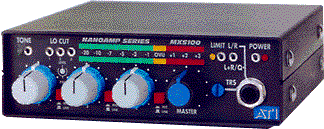
ATI's NanoAmp MXS100 3-input stereo mixer

The NanoAmp XPS100 and XPS200 expanders add additional inputs to the MXS100. The XPS100 provides four panned mic/line inputs and stereo buss out; the XPS200 offers two stereo line level inputs and stereo buss out. Both units plug into the MX100 for power and audio output with included cables. Multiple XPS modules can be used with the MXS100 in stacked or horizontal desk and rack mount configurations.

List pricing for the new NanoAmp mixer modules is $799 (US) for the MXS100, $549 (US) for the XPS100, and $379 (US) for the XPS200.

ATI also introduced the NanoAmp L200 2-channel line amplifier; and the BGD200 2-channel meter display, with phase indicator and headphone outputs, available in both VU and PPM versions (list $329 US each).
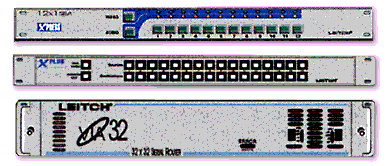
Leitch Shows Range of Digital Audio Converters and Routers at World Media Expo

Los Angeles, CA. Along with its customary array of video chain technology, Leitch Inc. is showing a new series of AES/EBU digital audio cards, interfaces and routers in their booth at World Media Expo. The audio series products, dubbed “AES Glue,” can be housed in the same frames as Leitch’s popular Digital Glue® products and inter-mixed with various modules.

The AES Glue line includes AES/EBU Audio Output Modules for Leitch’s DigiBus mounting frames (model 3160AO-S); the Digital Audio Reference Signal Generator (AES11-1993); AES/EBU Digital Audio Distribution Amplifiers (ADC-880, ADC-6880); and AES/EBU Digital-to-Analog (DAC-880, DAC-6880) and Analog-to-Digital Converters(ADC-880, ADC-6880); and a number of routing units, including the VIA? Digital Audio Switcher, and the X-plus™ AES/EBU Routing Module.


DigiBus AES/EBU Audio Output Module (Model 3610AO-S)

In addition to converting analog and digital signals, DigiBus supports both video and audio synchronization including audio embedding (multiplexing) and de-embedding (demultiplexing). The new AES audio output module may be added to a DigiBus frame to provide a cost-effective single function for outputting AES audio from a system, especially when demultiplexing.

AES11-1993 Digital Audio Reference Signal Generator

The Digital Audio Reference Signal Generator generates high-quality AES reference signals and test/alignment signals. The reference can be locked to composite video or AES2 signal, or it can be a free-running reference to AES11 Grade 2 performance. The generator outputs five or six AES11 Grade 2 reference signals at 44.1 or 48 KHz sample rates, and a one-word clock output. A sixth output is jumper-selectable to output any one of four signals.

AES-880 and AES-6880 AES/EBU Digital Audio Distribution Amplifiers

Leitch’s 110 and 75 ohm digital audio distribution amplifiers are differential input, eight-output units featuring cable equalization, data reclocking and contact closure output for remote error indication. Equalization and reclocking provide the ability to compensate for cable lengths exceeding 5,000 feet. Card-edge LED error indicators provide a quick and accurate assessment of the incoming signal integrity.

DAC-880 and DAC-6880 AES/EBU D-to-A and A-to-D Converters

Leitch claims exceptional digital audio conversion quality at unbeatable prices with these 20-bit converters. The units feature flat frequency response from 20 Hz to 20 KHz, dual outputs, and excellent linearity and signal-to-noise specifications. The dual outputs eliminate the need for DA’s after conversion and cut down on the amount of equipment and rack space needed. Both types of converters can be used in existing audio distribution amplifier frames or housed in the same frames as other Digital Glue products, allowing digital video and audio in the same frame.

VIA32 AES/EBU Digital Audio Routing Switchers

The VIA audio routers are available in both balanced and coax versions. They feature expansion capabilities up to 32×48 and 32×64 with additional frame and input distribution. These switchers can route any digital audio signal at any of the professional data rates such as 32, 44.1 and 48Khz. A wide-range of control options is availableas well, including Leitch’s Programmable Control Panels and Windows-based software.

AES Audio XPRESS Routing Switcher

Leitch’s XPRESS routers are designed for flexibility, to fit any production, broadcast or telecommunications monitor switching application. The new AES audio versions of the router include a serial video and AES combination; AES audio with 75ohm coax interface; AES audio with 110 ohm balanced interface; and AES only. They are compact, one-rack units with optional built-in analog video and analog audio monitoring output (this eliminates the need for external video and audio converters in installations where the XPRESS is used to feed a monitoring station).

ASR-8×8, 16×1 and 16×16 AES/EBU Routing Modules

The X-plus™ Series of routing switchers is a modular system featuring standard one- and two-rack unit mounting frames into which a wide range of modules can be installed such as AES/EBU 8×8, 16×1 and 16×16 sizes. Digital and analog, video and audio modules can be installed in the same frame and multiple frames can be combined to build complex multi-level systems.

The ASR-8×8 module requires one rear slot in an X-plus frame and receives both its computer controls and its power from the frame. With the 16×1 unit, a line-level analog stereo output provides a means for monitoring the digital audio. And with a secondary switching monitoring router, configurations of 64×1 to 4096×1 are possible. The X-plus ASR-16×16 can also be configured as two independent 8×8 routers or two 8×8 routers slaved together.

Telos Demos Audioactive MPEG ‘Net Streaming at WME

Los Angeles, CA. Telos Systems is demonstrating Audioactive™, its new Internet audio-streaming technology at the World Media Expo here. Audioactive made its online debut September 27 when Apple Computer used the Telos technology for live webcasts featuring Les Claypool of Primus from the Filmore in San Francisco, Me’shell Ndegeocello from the Strand in Providence, RI, and a live chat with The Cranberries plus an exclusive concert recording of the band.

Audioactive uses standard MPEG Audio Layer III coding and is based on Telos Systems’ experience and success providing high-quality audio tools for broadcast over dial-up networks including ISDN. All webcasts, including live music webcasts, are now available for real-time listening using the high-quality Telos format.

Crown Broadcast Intros 2 KW FM Transmitter at World Media Expo

Los Angeles, CA. Crown Broadcast will be showing off a new FM transmitter package in their booth at World Media Expo, at the Los Angeles Convention Center this week. The 2KW package combines Crown’s transmitter technology with a full-featured exciter, a new DC power supply and a 2 KW amp.

“We have gained quite a reputation for modular and reliable FM transmitters in the low power ranges,” commented Ben Dorsey, Information Manager for Crown Broadcast. “With this new package, we hope to demonstrate our commitment to higher power applications.”

The key distinguishing feature of the 2KW package is its efficiency. The broadband amplifier is 75-80% efficient across the band with no field or factory tuning required. It features a responsive protection mode where problems with output devices, over-temperature, high SWR, or high current simply reduce the output power to a safe level until repairs take place. In addition, the amplifier has hot-swappable 500-watt power modules.

The amplifier itself is only 4 rack units high and weighs less than 50 pounds. The separate DC supply is power factor corrected and provides 90% efficiency. It is 3 rack units high and weighs less than 40 pounds. There are only three connections between the supply and amplifier and both are designed to be easy and intuitive to operate.

The modular package can be used with a bundled Crown Broadcast exciter, or the Crown amplifier/supply can be used with a station’s existing exciter/IPA. A compatbible 1KW package is due to be introduced soon.

Put Your Radio Station on the Web: Integrated Package Shootout at NAB Radio Show / World Media Expo

Los Angeles, CA. Probably the hottest new-product rivalry at this year’s NAB Radio Show and World Media Expo (today through Saturday, Oct.9-12, Los Angeles Convention Center) is the battle of the integrated web site production packages. FreeRange Media and the Radio Data Group (RDG) have each launched suites of software designed to make it easy for radio stations to establish a live, interactive broadcasting presence on the Internet.

Free Range Media Inc. announced Audio Palette™, an “automated radio station website solution.” This package focuses on building a community at the web site, and delivering RealAudio” web-casting of broadcast content in both live and archival forms.

“Two key things necessary to create a popular website are to build delivery of fresh content and interactivity with the audience into the website, says Andrew Fry, President of Free Range Media. “Until now, this has been an expensive proposition for radio stations, because they demanded expensive development and maintenance. Our solution requires no custom development, it automates administration using our AudioVCR™ technology, and it incorporates our Community Suite™ of interactive and website administration products.”

The included AudioVCR module is a website audio administration tool. It allows the site manager to set blackout periods, record programs automatically, turn live feeds on and off, schedule live events, and to specify and sequence audio leads to precede retrieval of archived broadcasts. It is an integral component of easily and cost-effectively managing website audio content including advertisements the station sells.

Free Range points to an example station that is already up and running using the Audio Palette package. At KIRO Newsradio 710 in Seattle, traffic, news, weather and other scheduled broadcasts can be accessed by web listeners who were unable to listen to the radio wave broadcast. Listeners benefit from the value of accessing information they previously couldn’t on their schedule, and the station benefits by extending the time-value of their material.

“Giving our listeners 24-hour access to the latest information, even archived information is incredibly valuable,” says Tom Clendening, General Manager at KIRO. “Web access translates directly into increased listeners and that is what makes our business tick. As a business, we’re always looking for new sales opportunities and the website give us that.”

The software suite includes WebChat, WebNote (a bulletin board system), QuizMaster, SurveyBuilder, and six other interactive products that allow the station to query, poll and interact with its listeners during broadcasts or as part of promotional events, local community topics, national debates and more. These community-building capabilities have the advantage of creating new content for a station at little or no additional cost, along with a side benefit of attracting more listeners to the website.

Audio Palette requires RealAudio Server by Progressive Networks, and a Netscape, Apache, or NCSA web server. Minimum hardware requirements are a Sun Microsystems Sparc-5 running Solaris operating system, or a 133MHz Intel Pentium PC running Unix or Windows NT. Prices vary with the features purchased and start at $5,000 (US) per palette. A variety of specialized palettes will become available in the fourth quarter of 1996 including “Talk Radio,” “Rock-n-Roll,” “Classical,” and “Country-n-Western.”

RDG’s package is called MediaNext™, a “custom server software solution designed for even the most novice of Internet users.” The software allows a site manager to update the site on the fly, from any web browser, at any time. It features private password-protected administration pages on the web site. The webmaster fills in the blanks on the form, clicks a button, and the web page is immediately updated.

“This is an integrated solution for broadcasters who want to derive new revenue from the promotion and use of their web sites,” comments RDG President Michael Rau. “It’s for the station that can’t afford additional staffing to maintain those sites.”

MediaNext includes modules for updating text on the station site, including news, sports and weather pages (MediaText™); managing and updating hot links to other sites (RDG Link Manager); organizing, rotating, and billing for web site banner advertising (AdNext™); updating station events and/or a concert calendar (RDG Events Manager); and a listener database, demographics and marketing management tool (DataNext™).

“Our software makes maintaining and updating a web site as quick and easy as possible,” said Rau. “It puts the station in control. You shouldn’t have to rely on any third party to update your site.”

Other capabilities of the RDG package include a “Now On Air” page, which rotates pictures of air talent automatically to coincide with the broadcast schedule; Interactive Trivia, and an Interactive Guestbook.