Blue Sky Monitoring Systems Win Converts Among Top Engineers and Studios

Ever since renowned producer/engineer/mixer Roger Masson (Teraplane, Superfix, Phil Cody, Ken Burns “Jazz”) used Blue Sky monitors during work on special 5.1 elements for a recent Marilyn Manson DVD, he has been an avid Blue Sky fan.

Since that first exposure, Mr. Masson has been using the Sky System One 2.1 and 5.1 monitors for everything from tracking to overdubs, to mixing and mastering of complete album projects. He finds that Blue Sky monitoring works at every stage of the record-making process.

Blue Sky Brings Accuracy to a Temporary Recording Location

Most recently, Roger Masson has been working on the debut album of The Cribb, one of Los Angeles’ hottest young rock bands. He has set up a Blue Sky System One 2.1 monitoring system in a rented Spanish-style residential building in Los Angeles, a site the band members and Masson decided would make an excellent temporary studio, thanks to its acoustics and vibe. In post, Mr. Masson plans to use a Blue Sky 5.1 system to create a multi-channel mix of the recording, and all versions of the album will be mastered using Blue Sky monitors.

“This is the first time I’m using the Blue Sky speakers for tracking, and I just love them in this role,” comments Roger Masson. “They were always great to mix through, but it’s clear that Blue Sky can handle every aspect of the recording process, which gives me and the band a tremendously enhanced level of sonic consistency throughout the entire project.”

The Cribb’s project is also the focus of a forthcoming VH1 documentary about how private residences can be turned into recording environments. “This is a temporary recording space, so we could have put in any monitors we wanted,” says Mr. Masson. “We chose the Blue Sky monitors because we know that the accuracy level is high. They’ll act as the control reference of the recording space.

A Growing Number of All-Blue-Sky Facilities

Wabejon Entertainment is one of a growing number of all-Blue-Sky studios. Owner, record producer and label executive Eric Miller recently purchased two new Blue Sky 2.1 systems, to go along with the two Blue Sky set-ups already in service at the rapidly-expanding 7,000-square-foot audio/video facility. He plans to install a Blue Sky 5.1 surround monitoring system in a new SSL-based mixing studio, expected to go on line in May 2003.

Mr. Miller and Wabejon have established a solid reputation working with successful artists such as Sara (BMG), B5 (Bad Boy Entertainment), Sarai (Epic, hit single “Pack Ya Bags”), and Althea (Ill Na Na/Def Jam Records).

Will Baker (left) and Pete Woodruff (right) of Hitstreet Avenue, working on their latest project at Wabejon Entertainment

Wabejon has also been home to Will Baker and Pete Woodruff of Hitstreet Avenue, whose work work with India.Arie won 2 Grammy Awards on Feb.23 (Best Urban/Alternative Performance, Best R&B Album).

“The Blue Sky monitors are simply cleaner and clearer sounding than anything else,” Eric Miller remarks. “They’re very crisp sounding. Also, you get a tremendous amount of power from a speaker of that size. I can mount them on desktops or on stands and get full-range response. And by using Blue Sky speakers throughout our facility, we can have a consistent sound from studio to studio. The artists love them, and I love them.”

Blue Sky Monitoring Leads the Charge to Surround

Spectrum Recording Studios has been leading the charge for surround audio in South Florida, with the Blue Sky 5.1 monitoring system at the heart of its surround capabilities. Since a Blue Sky 5.1 system was installed at Spectrum, the studio has used it to mix a range of projects that reflect the diversity of the surround approach to audio. These include the DVD release of the recent PBS music special featuring big-band virtuoso Michael Civisca, produced by legendary arranger Charles Calello, as well as an ongoing project to create an entire library of surround-ready music pieces that will be compatible with film projects and digital broadcast.

Spectrum Studios is a top-flight two-room facility that has become a magnet for upcoming and established artists from around the country, including Juice Newton and Ronnie Milsap. Spectrum is also a major supplier of music content for the large Abaco Music Library, and music composed and produced by owner Jim Kalamasz has appeared on hit television shows including Malcolm In The Middle, The Drew Carey Show, and Saturday Night Live.

“Surround music is really on the verge of taking off in so many different applications,” says Mr. Kalamasz. “We’ve been positioning ourselves as the leading facility in this area for practical expertise in surround music mixing. The Blue Sky 5.1 system has played a major role in our success at that.”

Kalamasz first encountered Blue Sky monitoring at the 2001 AES Convention in New York City, and later heard the Blue Sky 5.1’s in action again at Room With A View Studios in Nashville, a facility Spectrum often collaborates with.

“I not only realized how good they actually are,” explains Mr. Kalamasz, “I also realized that our two studios could now share a reliable, accurate, and consistent 5.1 monitoring environment, which would significantly benefit our clients. The Blue Sky 5.1 monitors were the obvious choice, both for how they help our sound and how they help our business.”

Blue Sky Web Site

Blue Circle Audio Now Distributes Audiomeca Reference-Quality CD Player & Turntables in Canada

Blue Circle Audio, the Canadian manufacturer of high-end tube and hybrid tube/solid-state audio electronics, has announced that it is now the Canadian distributor for Audiomeca products.

Audiomeca's Mephisto CD Player features a custom-built transport mechanism, low-jitter performance, all-gold connectors

The Audiomeca line-up of reference-standard analog and digital sources, developed by Pierre Lurne in France, make a great complement to Blue Circle’s own range of audiophile electronics.

Audiomeca makes several CD players and transports (Keops, Mephisto II.X), a DVD player with enhanced audio capabilities (Kimera), a digital-to-analog convertor(Enkianthus.X), turntables and tonearms (Romance, J1), generally priced in the $3,000 – $10,000 (CDN) range.

Blue Circle specializes in amplifiers in a wide variety of configurations, including preamps; monoblock, stereo and multichannel power amps; and integrated amps. Blue Circle also makes a solid-state phono stage, power line conditioning systems, cables and related accessories.

Blue Circle Audio Web Site

Audiomeca Web Site

Audiomeca's Romance Turntable and Romeo Tonearm

Manley’s New MAHI 40 Watt Monoblock Tube Amp is Now Shipping

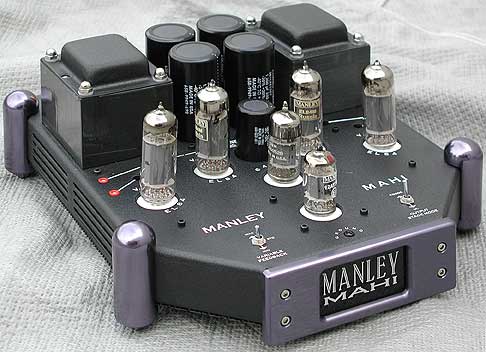
Esoteric tube gear manufacturer Manley Laboratories has begun shipping the new MAHI monoblock amplifier. The MAHI is an update of the EL84-tube-based 50 watt monoblock design Manley has been producing under one name or another since 1993.

This latest revision comes in all-new styling, looking like a mini version of Manley’s Snapper 100 Watt mono amp. Conceptually (and electronically) however, the MAHI is a mono version of the Stingray stereo amp introduced last year.

"They are so cute," says Manley Labs CEO EveAnna Manley of the new MAHI mono amp, which features Triode/Ultra-Linear mode switching, and high energy B+ rail capacity

Like the Stingray, the new MAHI can be switched between ultra-linear operation (40 Watts) and triode mode (20 Watts). It is designed around a quartet of EL84/6BQ5 tubes, driven by a 6414 dual triode driver and a 12AT7WA input dual triode.

“The Ei Yugo EL84 has been one of our very favorite tubes for many years,” says Manley CEO EveAnna Manley. “They are extremely long lasting and reliable, and can be considered the smaller brother of the much-beloved EL34: really quick-sounding both in the bass and especially in the top end. And of course this has a lot to do with our Manley Output transformer, the same one we build for the Manley Stingray.”

Another key design feature is the MAHI’s increased B+ rail capacity. The earlier Manley 50 watt monoblocks had around 49 Joules of energy storage in the B+ rail. Now the MAHI’s have nearly 180 Joules of energy storage, and you can hear this improvement especially in the bass region: tighter, faster, deeper.

The Manley MAHI monoblocks are now available with a suggested retail price of $2500 (US) per pair.

Manley MAHI Features and Specifications

  • Vacuum Tubes: 4 x EL84 Output, l x 12AT7WA Input, 1 x 6414 Driver
  • Output Power: 40 Watts
  • Freq. Response +.5 dB: 10 Hz – 90 KHz
  • Input Sensitivity: 460 mV nominal
  • Input Impedance: 100 Kohm
  • Load Impedance: 5 ohm
  • S/N Ratio @50W: -80 dB
  • Dynamic Range: 86dB
  • Power Consumption: 100 Watts (idle)
  • 168 Watts (Full Power)
  • Dimensions: W=12″, D=10″, H=5″
  • Shipping Weight: 17 Ibs. each

Manley Laboratories Web Site

Arturia’s New Moog Modular V for Macintosh and Windows Will Have Approval of Bob Moog

Early announcements of Arturia‘s new software emulation of the classic Moog Modular synthesizer referred to it as the Modular C3. But it turns out that the original Modular’s creator, Bob Moog himself, is going to be involved in the marketing of Arturia’s emulation, and that has led to a name change. Henceforth, it is the Moog Modular V (the ‘V’ is for Virtual).

Arturia’s software reproduction of the legendary Moog, one of the most influential and recognized synthesizers of all time, appears to be thoroughly faithful to the original. It replicates all of the functions and parameters of the original Moog Modular, including modules such as the Moog 921 oscillators, the Moog 911 envelope generator, and the Moog 960 3×8-step sequencer.

The Modular V uses TAE®, a new set of synthesis algorithms created by Arturia’s engineers, specifically addressing the peculiarities of emulating classic synths. TAE stands for True Analog Emulation, and Arturia says the new algorithms deliver superior audio quality when reproducing analog circuits.

In particular, TAE avoids any sort of aliasing, and provides alias-free oscillators with wave forms indistinguishable from those generated by analog hardware circuits. It is also able to emulate the notorious instability of hardware oscillators, including the soft-clipping and micro-variations typical of vintage hardware oscillator and filter circuits. Arturia says this is the secret to recreating the warmth and character of vintage synths.

The Arturia Modular V is a stereo synth, and it can be run as a stand-alone application, or as a plug-in virtual instrument. It runs at 32-bit, 96 kHz resolution. The package includes a 450-page manual in 3 languages (English, Japanese, French), and a bundle of more than 400 presets, developed by top sound designers.

The Modular V will be available in March for both Mac and Windows PC environments, with a street price of $299 (US).

Features of Arturia’s Moog Modular V:

  • 9 oscillators (921 Moog series)
  • 2 dedicated LFOs
  • 3 filter slots can be chosen among classic Moog 904 series (low-pass 24 dB, high-pass 24 dB, filter coupler), and an additional 20 dB multimode filter (7 modes)
  • 1 noise generator (white and pink — 923 Moog module)
  • 6 ADSR auxiliary envelopes (911 Moog module)
  • 2 VCAs (with their own envelopes, and 1 panoramic potentiometer for natural stereo effects)
  • 16 auxiliary VCAs with modulation inputs
  • 1 sequencer (3×8 steps — 960 Moog module)
  • 1 filter bank (14 bands with their own bandwidth)
  • 1 stereo delay
  • 1 chorus
  • Mono/polyphonic (up to 64 voices)

Arturia Web Site

Platinum Phase II Completes PSB’s New State-of-the-Art Home Theater Speaker Series

PSB Speakers showed off their newest loudspeaker series at CES last month, demonstrating 3 new models in the Platinum Series, alongside the original 4 designs that were launched late last year.

The new Phase II group, shown for the first time at CES 2003, consists of the T6 Tower ($4,700 US per pair), the C2 Center Channel ($1,200 US), and the SubSonic10 subwoofer ($$2,000 US). The new models will begin shipping sometime in the first quarter of 2003.

The original Platinum Series speakers, already available in stores, include the T8 Tower ($6,500 US per pair), the M2 Mini Monitor ($1,700 US per pair), the C4 Center Channel ($2,000 US), and the S2 Bipolar Surround ($2,300 US per pair).

PSB says that every speaker in the Platinum Series will meet and exceed the expectations of high-end speaker buyers who want both maximum musical realism and maximum home-theater impact.

“The PSB Platinum Series is our answer to the many listeners who have wondered how much further we could go beyond the celebrated qualities of our Stratus models,” comments PSB founder and chief designer Paul Barton.

“We looked long and hard at that, and identified ways to make meaningful, really audible advances in performance, yet still maintain the value that has always characterized our speakers. I think there will be quite a stir about these speakers.”

The company points to its sophisticated design and measurement techniques as reasons for the Platinum’s superior performance. They have been designed from the ground up using the most advanced design tools, such as Finite Element Analysis (FEA), laser vibrometry and computer optimization.

More importantly, the drivers, crossovers and the final products were designed and developed by Mr. Barton through objective measurements and critical listening tests at the world-renowned facilities of Canada’s National Research Council.

The flagship tower speaker, the Platinum T8, uses seven new drivers: three 8-inch woofers, two 4-1/2-inch midrange drivers (all with woven fiberglass cones and rubber surrounds), plus two 1-inch aluminum-dome, low-resonance tweeters. One tweeter faces forward and the other (which can be enabled or disabled by use of a jumper) fires to the rear. The midrange drivers and the front tweeter are placed in a D’Appolito array that focuses their wide and smooth range to provide exceptionally open, lucid, and dynamic sound over an unusually large horizontal and vertical “sweet spot” with superb clarity, so that groups of listeners can enjoy maximum definition of movie dialog, effects and music.

The three woofers employ 40-ounce magnet structures for exceptional bass control and power handling. The midrange drivers use a 20-ounce magnet structure, while that of each tweeter is 16 ounces. The 10-1/2 W x 46-1/2 H x 16 D-inch enclosure is available in black ash or cherry, with a distinctive die-cast aluminum base, top, and side extrusions that, as in the other systems in the new series, help provide structural rigidity for reduced cabinet resonance. The system’s striking appearance is “form-follows-function.”

The new, smaller T6 tower is a three-way bass reflex design also using the D’Appolito Array configuration consisting of a 1″ aluminum-dome tweeter flanked by two 3 1/2″ midrange drivers. Three 6 1/2″ woofers complete the driver complement.

“The transparency and dynamics of these speakers is going to get audiophiles talking,” Mr. Barton says, “as will the pristine midrange and low-frequency impact. And the appearance and build quality are going to turn some heads as well.”

The Platinum C4 center channel speaker employs the D’Appolito-array, with two 3-1/2-inch midrange drivers flanking the same 1-inch aluminum-dome tweeter used in the T8 and T6. Two 6-1/2-inch drivers flank the three-driver D’Appolito array.

The new C2 center channel is considerably smaller, employing a two-way bass reflex design with a 1″ aluminum dome tweeter flanked by two 6 1/2″ woofers.

The midranges and woofers on both center channel designs utilize woven fiberglass cones and rubber surrounds. They are meticulously “timber-matched” to preserve the tonality and dimensionality so critical to convincing surround sound performance.

Also new in the Phase II group is the SubSonic10 Powered Subwoofer. It consists of two 12″ high power, long-throw woofers in a bass reflex design powered by an internal BASH, Class H amplifier. This subwoofer yields 500 watts RMS of remarkable power with 1500 watts dynamic peak power – a powerhouse for even the most sophisticated home theater systems.

Proprietary “smart bass” circuitry prevents amplifier overload even under the most extreme drive conditions. The SubSonic 10 high-impact, accurate ultra-deep bass is rated at an earth moving 22 Hz and below.

For the many listeners who value the imaging and spatiality of mini-monitors, as well as the way they slip into a modest-sized listening-viewing environment, another Platinum entry, the M2, combines a new 6-1/2-inch woven-fiberglass-cone, rubber-surround woofer with the series’ new 1-inch aluminum-dome tweeter. The enclosure measures 9-1/4 x 15-1/2 x 12 inches.

Completing the Platinum line-up, the bipolar Platinum S2 surrounds place two sets of the same drivers used in the M2 mini-monitor (6-1/2-inch woven-fiberglass-cone woofer, 1-inch aluminum-dome tweeter) at a 90-degree angle to each other. This provides a combination of sonic diffusion and excellent localization of effects and instruments – for the best of both worlds in surround sound. The enclosure measures 15 x 15-1/2 x 9/24 inches.

All Platinum Series loudspeakers are available in real wood veneer, with distinctive die-cast aluminum ends and extrusions, contributing to the overall visual appeal of the speaker, in addition to lowering cabinet resonances. The aluminum clad front panels are both a structural feature and striking visual presentation for listeners who prefer to listen with the grille removed. These speakers are provided with dual, 5-way gold-plated, solid metal binding posts plus adjustable spikes and levelers, and are magnetically shielded, for use in proximity to video monitors. All woofer midrange drivers utilize woven fiberglass cones. The finishes and cabinet construction are consistent throughout the line for easy mixing and matching of various models.

“These are exciting products,” says Mr. Barton. “We think they are going to redefine a lot of people’s expectations of high-end performance.”

PSB Speakers Web Site

More News from CES 2003