Developers Get Added Support: Brian Eno Leads the Way

Creative also paid due attention to the all-important producers and developers, without whom the new hardware features won’t mean a whole lot to many consumers. The company will release a range of tools for developers, including API’s, hardware and software. The developer tools will provide support for DOS, Windows 3.1 and Windows 95 environments.

Leading the way in creating new application capabilities for Sound Blaster, Creative’s COMDEX booth was showing off composer/producer Brian Eno’s “Generative Music 1,” a real-time computer-generated composition for the PC that creates evolving musical pieces each time it is played. Creative’s cards with the EMU8000 music chip (AWE series) are the only sound cards capable of supporting Eno’s piece, composed with SSEYO Ltd.’s Koan Pro authoring software.

Eno used the software to construct a set of automatic controls for more than 150 musical and sonic parameters supported by the AWE cards. “The works I have made with this system symbolize to me the beginning of a new era in music,” said Brian Eno. “Like live music, it is always different. Like recorded music, it is free of time-and-place limitations: you can hear it when you want and where you want.”
Software Upgrades for Current Owners

Not wanting to leave its user base of 30 million Sound Blaster owners out in the cold, Creative also announced at COMDEX that it will offer software upgrades to current users. The upgrades will be made available at retail, directly from Creative, and from Creative’s web site “Creative Zone”.

A trial version of the upgraded technology, called NetSynth, will be available from the web site in December. The plan is to make the new technology widely accessible to all PC users in order to raise the standard and broaden the installed base of Sound Blaster enabled users.

Upgrades for Sound Blaster 16 users will offer Creative WaveSynth, adding 32-note polyphonic wave synthesis and an effects engine. For Sound Blaster AWE32 owners (or SB32 with added RAM), the upgrade will also include the Sondius WaveGuide technology, effectively bringing

Creative Labs Introduces “Pro” Version of SoundBlaster

Las Vegas, NV. At COMDEX Fall’96, several new products announced by PC audio card leader Creative Technology Ltd. have mapped out a strategy intended to raise the quality standards bar for audio on home PC’s to what the company refers to as “professional” level.

The new products, all due to ship in January 1997, include a new generation of the Sound Blaster® series of sound cards, and new software and upgrades for both consumers and developers.

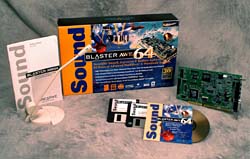
In the Sound Blaster line, the new introductions are the AWE64™ and AWE64 Gold™, which build on the successful AWE32™ model introduced last year. The new Sound Blasters deliver an advanced feature set for synthesis and record/edit applications, while maintaining compatibility with all of the previous Sound Blaster products.

Advanced features on both cards include…

  • 64-note MIDI polyphony
  • realtime digital effects and SoundFont downloadable samples
  • RAM upgradeable to 28MB for adding SoundFont sample banks
  • proprietary Wave Effects Synthesis with a patented multi-point interpolation algorithm for smooth reproduction and minimal distortion
  • Sondius™ WaveGuide synthesis for expressive, mathematically modeled music output
  • 3D Positional Audio spatialization
  • full-duplex capability for Internet communications and simultaneous playback and recording

Additional features of the AWE64 Gold include…

  • SPDIF digital audio output
  • 4MB of RAM standard on the card for better quality MIDI playback
  • 2MB, 3.5MB and 4MB General MIDI SoundFont banks onboard
  • gold-plated RCA connectors for line level outputs

Creative says it is targeting a home-hobbyist and consumer market interested in creation and playback of audio that rivals what is produced in professional recording studios.

“The Sound Blaster AWE64 Gold is a result of Creative’s pursuit for uncompromised audio fidelity,” says Sim Wong Hoo, Chairman and CEO of Creative Technology Ltd. “With these new products, and more to come, we expect a paradigm shift in the music creation, publishing and distribution industry that will result in a larger, expanded market.”

Both new cards come with a microphone and a complete suite of applications that provide tools for recording, playback and customization. Creative also bundles a set of Internet applications for browsing, streaming audio, Internet phone calls and conferencing. The Sound Blaster AWE64 Gold will have a retail price of $249 (US), and the regular AWE64 will go for $199 (US).

Apple Investigates New Technology to Stream Synthesized Speech Over the Net

Cupertino, CA. With uncompressed audio over the net weighing in at upwards of 500 kbits/second, and the most heavily compressed speech files moving at around 8 kbits/second, Apple Computer figures there’s room for a new bandwidth-saving approach to moving speech across the web.

Apple engineers think the answer may be SPIDI (Streamed Phoneme Intonation Description Interchange), which couples a MIDI-like data description protocol with Apple’s speech synthesis software technology. Their goal is to provide natural, human-like speech at a very low bandwidth for interactive multimedia distribution.

Rather than encoding audio data in terms of digital samples, SPIDI represents speech as a sequence of basic sound units, or phonemes, combined with information about the rhythm and inflection of these sounds. The result is a form of synthetic speech which captures the emotion and emphasis used by human speakers, but which takes up only about 0.8 K bits per second of transmission bandwidth.

Creation of data in the SPIDI format requires a special authoring tool which uses speech recognition to extract vocal inflections from recorded human speech. SPIDI’s inflected data is played back using Apple’s existing synthetic voices (PlainTalk system software).

The SPIDI team is developing cross-platform player components that will be integrated into the QuickTime Media Layer (QTML) architecture. If they get the job done, it will mean that spoken-word audio can be delivered over the Internet without disruption even in low-bandwidth settings. The technology is also said to address the media authoring problem of maintaining lip synch.

Phil Ramone Joins Web Audio Venture N2K, Will Head Internet Music Label

Eight-time Grammy winner, record producer Phil Ramone, has been hired by web music producers N2K (“Need To Know”) to create a music label linked to the Internet.

Ramone will be President of a division to be called N2K Encoded Music. In his new post, Ramone, will sign artists from all musical genres. He will also oversee the Music Boulevard site, one of the web’s most popular CD retail sites.

The first Encoded Music release is scheduled for early next year. It will be a compilation of the most popular jazz music chosen in a poll on N2K’s Jazz Central Station web site. All Encoded Music releases will be in the enhanced CD format, which plays on regular compact disc players and computers. Each disc will link users to an N2K-produced artist site on the Web.

Earlier this month, Music Boulevard presented Sammy Hagar at the AES Convention in Los Angeles. Hagar demonstrated a web audio transmission of unreleased music from his web site, via high-quality Liquid Audio technology. And in September, the company released a David Bowie single that was only available at Bowie’s web site (also created by N2K).

Eventually, N2K hopes to allow users to download entire recordings to their computers as direct purchases. They also intend to host cyberconcerts on the web. Other N2K web sites currently online include Classical Insites and Rocktropolis.